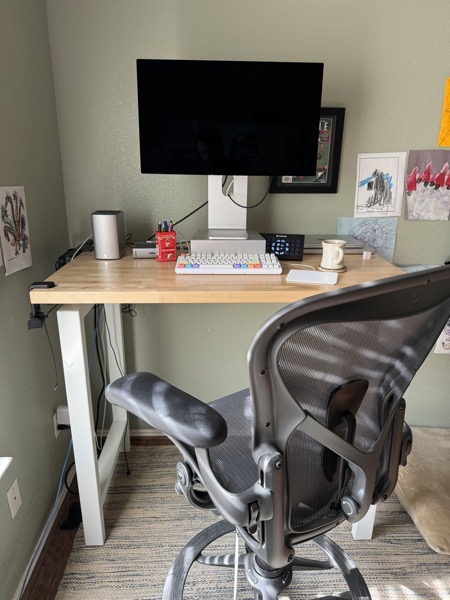
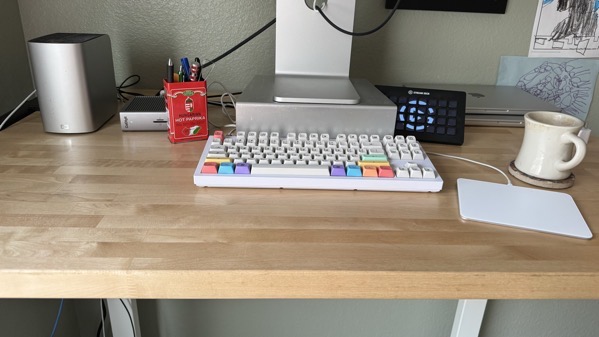
Inspired by the folks over at MacStories adding a new section dedicated to their setups, I figured now would be a good time to write about my own workspace. It’s actually something I’ve been meaning to write about for some time now as I’ve made several upgrades over the past year and have never been happier.
Let me start by saying that I see my workspace as an area worth investing in. That is to say while I am frugal with other things, like my car, my workspace is an area that I am willing to pay a premium for a nicer experience. In addition to using computers for my hobbies, I also work from home. This means I currently spend most of my waking life at my desk. I appreciate a nicer workspace much like someone who drives a long commute appreciates a nicer car. With that said, here is my current workplace.
Ergonomics
Standing Height 4-Leg Table by UPLIFT Desk
I currently use an Uplift Standing Table as my desk. Why a table? The best way to answer that is to talk about its predecessor and my first standing desk, the IKEA Bekant. The Bekant is a typical sit/stand adjustable desk, in that it can be raised and lowered between standing and sitting positions. You don’t have to be particularly observant to notice that the Bekant has only two legs. While I was never worried about its overall stability, I found the two-legged Bekant very slightly, but very noticeably bent with any amount of force on its surface. This bending combined with a VESA arm meant that my display would also ever so slightly bounce while typing. This bouncing was annoying the same way a slightly wobbly chair is annoying. You think it won’t bother you at first, but soon you can’t ignore it.
When I started looking at alternative standing desks, I found almost all of them also had only two legs. While it was possible, if not likely, other desks would be a bit more solid than the IKEA discount special I had grown to loathe. There was no way for me to know. Also and importantly, I never used the sitting position with the Bekant and almost all standing desks on the market are also of the sit/stand adjustable variety.
This Uplift Standing table has four legs and therefore does not bend an inch. Not being sit/stand adjustable also makes it much more affordable, so much so that I could get a much nicer birch butcher block top. I strongly prefer the feel of this butcher block to the laminate of the Bekant it replaced.
Herman Miller Aeron Stool
The reason I don’t need an adjustable standing desk is because I use a stool for my sitting needs1. My current stool is a Herman Miller Aeron, which I love. I also considered Steelcase. My wife equally loves her Gesture and while Steelcase offers it as a stool, the stool version felt like an afterthought on Steelcases’s own website2. By comparison, the Aeron Stool has been around long enough that I never worried Herman Miller might soon deny its existence. Finally, the Aeron has been the standard in office chairs for as long as I can remember. Of course it looks and feels great. I suspect there are only two kinds of people who complain about the Aeron:
- Those who are dealing with a decades old and poorly treated hand me down that was likely acquired by their employer in the most recent of a series of startup liquidation auctions.
- Those who lament that their perfection has made them too ubiquitous and thus boring. (See also: some typography nerds with Helvetica).
Peripherals
The Apple Studio Display With Tilt and Height Adjustable Stand
This could just as easily go under the “ergonomics” section above. At six feet, I would say I am on the tall side of average. I have a problem with hunching and tend to hunch even more when using a display that is only raised the typical handful of inches. This originally led me to buy a VESA arm, which raised my display significantly, up to around nine or ten inches. This was great, but it exacerbated the aforementioned bouncing issue I had with the Bekant standing desk. The Apple Studio Display with the tilt-and-height-adjustable stand, combined with an old Satechi riser has worked perfectly for my needs. While standing, the display is a whopping 13.5 inches above my desk, which I lower to 10.5 inches while sitting.
Display wise… look, no one needs a four figure 5K display, especially when there are a plethora of much cheaper non-5K displays on the market, but hear me out. The 5K iMac spoiled me, sort of like how I imagine a luxury car spoils drivers. Once you get used to that many pixels, it’s hard to go back. 4K just isn’t good enough, and you know where perfectly crisp 2x Retina arguably matters most? Text. As an engineering lead what am I staring at most of my days? Text!
My Crazy Semi-Custom Keyboard
This is as much a hobby as it is a tool. Like other old Mac nerds, I imprinted on the Apple Extended Keyboard II . I still love that keyboard, but dear god is that thing an aircraft carrier on the desk. Furthermore, there has never been a better time to get into mechanical keyboards as there is currently a great community and market around them. My current build is the following:
I am not particularly picky with keyboards. I didn’t even hate the feel of the notorious butterfly keyboard on Touch Bar MacBooks, but this keyboard feels and sounds so satisfying to me that I actually look forward to typing on it3.
Apple Magic Trackpad 2
Some people still prefer a traditional mouse. I respect their choice, but can’t imagine myself going back to one outside of gaming for three reasons:
- Trackpads make horizontal scrolling and pinch to zoom as easy and intuitive as vertical scrolling, which is super nice when I’m editing spreadsheets or images.
- Using a trackpad at my desk keeps things consistent with using the trackpad built into the laptop.
- Scrolling the wheel on a wheel mouse always felt like something that would accelerate carpal tunnel.
AirPods Max
The AirPods Max sound great. They also have excellent noise cancellation, which I find myself using regardless of whether or not I am listening to music. Wearing noise cancelling headphones without any audio may seem ridiculous, especially for someone who works in a relatively quiet home office, but something about dulling my hearing helps me focus. Finally, their integration in Apple’s ecosystem makes them easy to use with both my work and personal laptops.
Elgato Stream Deck
The much maligned Touch Bar actually made sense once I started using it to run automations. Now that the Touch Bar is no more, I have an Elgato Stream Deck. Using it with Apple’s Shortcuts, I now have hardware buttons for some of my most common tasks, like rating music, setting common Slack statuses, joining Zoom meetings, or getting a song from my local radio station. These hardware invoked shortcuts have saved me countless minutes while removing friction.
CalDigit TS4
Being a remote worker means this workspace is shared between my work and personal laptops. Switching back and forth between the two easily is paramount. Thunderbolt docks provide a one cable solution that make sharing peripherals between multiple laptops a breeze. The dock I have been using is the CalDigit TS4. There are now a multitude of Thunderbolt docks on the market. I chose the TS4 because the CalDigit Thunderbolt 2 dock I was using before lasted me seven years and still works today. Connected to it is ethernet, a backup disk, the Studio Display, my keyboard and Magic Trackpad, and the Stream Deck, all through one cable that also charges whichever MacBook Pro is connected4.
Western Digital MyBook Raid and Nightly Time Machine
This is what I use for my Time Machine backup disk. It’s a decade old, uses Thunderbolt 2, and is connected via my dock using Apple’s pricey adaptor. Nightly Time Machine is my solution for preventing Time Machine backup disks from automatically mounting on my personal laptop until just before backing up in the middle of the night. I have separately prevented my Time Machine disk from ever mounting on my work laptop5. Functionally this means that it’s almost always safe for me to unplug my Time Machine backup disk from either laptop without getting the dreaded “disk not ejected properly” notification of shame. It also means the disks inside the MyBook aren’t spinning during waking hours, keeping my workspace free from technological hums.
Honorable Mention
Szeged Hot Hungarian Paprika Tin
A friend of mine introduced me to paprikash, a deliciously spicy Hungarian dish with noodles or rice, onions, sour cream, and chicken. The recipe calls for hot paprika, and the first company I found that offered hot paprika was Szeged. It comes in a fun tin that works great for holding writing implements.
Figuring out how to best utilize any new space has always taken me considerable time. My workspace is no different. I’ve been working from home full time for just over half a decade. While I’ve never felt uncomfortable in my various workspaces over those years, it’s taken until this year to finally settle on a workspace I truly enjoy. Tastes differ and I don’t expect anyone would enjoy this workspace as much as I do. My hope is that the items and reasoning on this list helps others find build their own perfect workspace.
Update: Added Photos of my workspace.